
Can Humidity Control Help You Stay Comfortable at Higher Thermostat Settings?

In some homes, controlling humidity may help occupants remain comfortable at higher thermostat settings, potentially limiting unnecessary cooling demand.1,2,3
How Humidity Affects Perceived Temperature
If you’ve ever stepped outside on an 85°F day and thought, “It feels hotter than 85°F,” you may have already experienced humidity’s impact on comfort.
Because humid air can make it hard for occupants to feel comfortable, managing indoor humidity may help support a more comfortable indoor environment. This is why humid conditions often feel more oppressive than dry conditions at the same temperature.
Research from the National Renewable Energy Laboratory (NREL) found that at a common summer thermostat setting of 75°F, perceived temperature can vary by as much as 11°F depending on indoor humidity levels.1 In other words, two homes at the same temperature can feel dramatically different simply because of moisture in the air. For many homes, maintaining indoor humidity between 30% and 50% can help support comfort while limiting excess moisture.4
Can Low Humidity Make Higher Thermostat Settings Feel Comfortable?
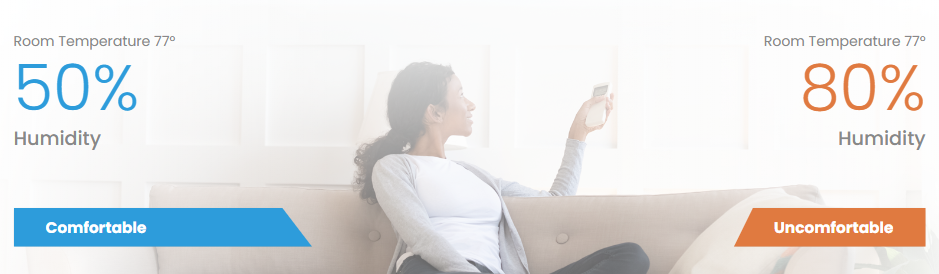 NOTE: Indoor comfort perceptions vary by individual. While certain temperature and humidity ranges are commonly associated with comfort, actual results may vary based on personal preferences, home construction, system design, installation, maintenance, and operating conditions.
How Humidity Control May Help Reduce Cooling Demand
Here's where things get interesting: When homeowners can remain comfortable at slightly higher thermostat settings, cooling energy demand may be reduced.2,3
Research from the U.S. Department of Energy’s Building America program shows that humidity control plays an important role in maintaining comfort and influencing overall energy use in hot and humid climates.2,3
Instead of chasing low indoor temperatures, the focus can shift to creating a balanced indoor environment where temperature and humidity work together. For homeowners considering a new HVAC system, the way a system manages humidity can be just as important as how it cools the air.
compared to systems that frequently cycle on and off.2
Advanced heat pumps and air conditioning systems with two-way, communicating inverter technology, like the Daikin FIT, are designed to make small, precise adjustments continuously adjusting cooling output based on indoor conditions. Because these systems with inverter technology are designed to run for longer periods at lower capacities (compared to traditional single-stage systems), this may help improve humidity control by allowing the cooling coil to remove moisture from the air over a longer operating cycle.6
Homeowners considering HVAC replacement may wish to discuss humidity-control goals, equipment options, and overall system design with a qualified HVAC professional to determine the most appropriate solution for their home.
HVAC Features That Help Improve Humidity Management
- Two-Way, Communicating Adaptive Inverter Technology
Systems with two-way communicating, adaptive inverter technology, like the Daikin FIT, are designed to operate for longer periods at lower speeds compared to single-stage systems, which may help support more consistent moisture removal and temperature control when properly selected, installed, and maintained.2,5
- Smart Thermostats and Humidity Sensors
Select advanced HVAC controls, like the Daikin One+ smart thermostat, are designed to monitor both temperature and humidity by adjusting system performance to maintain balanced comfort.2
- Properly Sized HVAC Equipment
Oversized air conditioners may cool too quickly, reducing the time needed for effective moisture removal. Correct sizing is essential for comfort and humidity control.2
Is Raising Your Thermostat Right for Your Home Comfort?
If your home often feels sticky, clammy, or muggy, even while the air conditioner or heat pump is running, it may be worth evaluating humidity levels.
Effective indoor humidity control can help your home feel cool, fresh, and comfortable while supporting indoor air quality and overall home performance. In some cases, managing excess indoor moisture may even allow occupants to remain comfortable at slightly higher thermostat settings.1,3
- National Renewable Energy Laboratory (NREL). “Improving Comfort in Hot-Humid Climates with a Whole-House Dehumidifier.” November 2013. https://docs.nlr.gov/docs/fy14osti/60188.pdf
- U.S. Department of Energy. “Advanced HVAC Humidity Control for Hot-Humid Climates.” April 2024. https://docs.nlr.gov/docs/fy24osti/83357.pdf
- NREL Building America. “Evaluation of Humidity Control Options in Hot-Humid Climate Homes.” December 2011. https://docs.nlr.gov/docs/fy12osti/50671.pdf
- U.S. Environmental Protection Agency. “Care for Your Air: A Guide to Indoor Air Quality.” September 8, 2025. https://www.epa.gov/indoor-air-quality-iaq/care-your-air-guide-indoor-air-quality
- Texas A&M University. “Quantifying the Performance of Variable-Speed and Single-Speed Heat Pumps in Residential Cooling and Demand Response Applications.” August 2025. https://oaktrust.library.tamu.edu/items/8a20c44d-b62a-45ba-b507-4f1180e69307/full
- Department of Energy. Building America Solutions Center. “Variable Speed HVAC System.” https://basc.pnnl.gov/building-science-measures/variable-speed-hvac-system
In this article
Connect on Social Media
 Follow on Facebook
 Follow on YouTube
 Follow on Instagram
 Follow on X
 Follow on TikTok
 Follow on Pinterest

Looking for help now?
Enter your zip code to search for Daikin Contractors in your area.
Learn More
Learning Center Content
Stay informed about home comfort technology, when to upgrade, energy efficiency, and reducing your energy bills.

Cold Climate Heat Pumps: Efficient Heating in Freezing Temps
3 Nov 2025
For homes in northern states or Canada, cold winters can raise questions about whether a heat pump can provide sufficient heating. A unit rated only for mild conditions may struggle or switch to backup electric heat in cold and icy conditions. Modern technology has addressed these concerns, and select cold-climate heat pumps are designed specifically for low-temperature locations.

Can Humidity Control Help You Stay Comfortable at Higher Thermostat Settings?
29 Jul 2026
Think your thermostat tells the whole comfort story? Humidity can change how warm or cool a home feels, and too much moisture in the air may make even moderate temperatures feel muggy or uncomfortable for some occupants.

How Inverter HVAC Systems Are Designed to Impact Your Energy Bills
8 Jul 2026
Understanding your home’s energy use can start with learning about your HVAC system’s efficiency and the technology behind it. Inverter technology offers an efficient way to heat and cool your home, helping to maximize your comfort while managing energy use. This article explains how inverter systems work and how they are designed to affect your monthly energy costs.

Rising Electricity Rates: How Smart HVAC Choices Can Help Homeowners
27 May 2026
For homeowners concerned about rising electricity rates, heating and cooling efficiency is one of the most practical ways to manage long‑term energy costs, especially as the power grid faces increasing demand.
Air-to-Water Heat Pumps: The Water Home Comfort Solution Explained
17 Apr 2026
Considering replacing your fossil-fuel boiler with something new? Tired of maintaining a separate boiler, AC unit, and water heater? Air-to-water heat pumps are a modern, 3-in-1 answer to your total home comfort.